 by
by “I don’t know who I am anymore, but I know what I have to do.”
It’s fitting that All In returns to Texas, a place where feuds become legend and where men face their reckonings beneath a scorching sun. There, in the shadow of the Lone Star, Hangman Adam Page and Jon Moxley are set to write the next, and perhaps final, chapter of a story that has spanned years, shattered friendships, and changed the very soul of AEW.
The AEW Men’s World Championship is on the line. But that belt is more than gold. It’s a mirror, reflecting not just the man who holds it, but what the company has become. And if AEW has a main character, a flawed hero shaped by violence and vulnerability, it’s Hangman Page.
Across the ring stands Jon Moxley, the reigning champion, the standard bearer of pain, and the architect of AEW’s most terrifying ideology: the Death Riders. He doesn’t just want to beat Hangman. He wants to break him. Mold him. Force him to embrace the darkness he’s flirted with for far too long.

Chapter One: Hangman Steps Out of the Shadows
(Editor’s Note: For a full deep dive into Hangman’s history with The Elite, please refer to A Walk in The Shadows, and Stepping Out of the Shadows.
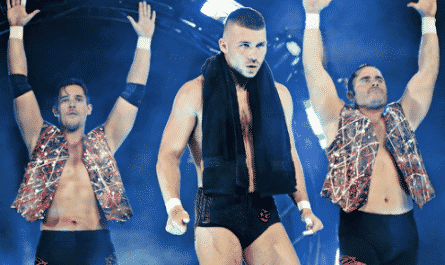
The announcement of All Elite Wrestling was just the spark everyone had been waiting for. In the quiet hours of the new year in 2019, Cody Rhodes, The Young Bucks, and Hangman Page revealed the dream of a future built on revolution: AEW: Double or Nothing. The members of The Elite (including Kenny Omega) would embark on this new road with new roles as Executive Vice Presidents. But Hangman? He wasn’t an EVP. He wasn’t yet The Guy. Hell, he wasn’t even “Full Gear ready.” But he was our guy.

Even in the grand pomp and circumstance of rallies, the first show, and that first summer year of AEW, Hangman still stood out. Over time, he became the main character of AEW because he personified what AEW itself was supposed to be. An underdog filled with fighting spirit. A man strong enough to fight the world, and human enough to stumble through it.
Hangman drank with his friends, laughed at himself, grappled with self doubt, and carried a quiet kind of hope, that maybe someone like him could make it if he tried hard enough. Hangman was our anxious millennial cowboy, a rebel with a cause, grappling with doubt while delighting in silly and joy.

After winning the inaugural Double or Nothing Casino Battle Royale, Hangman was set on a trajectory to become AEW’s first Men’s World Champion. However, he wasn’t ready yet. It wasn’t his time. Chris Jericho, defeating Hangman Page, went on to claim that title instead. While he was with The Elite, he was surrounded by the Best Tag Team in the World in the Young Bucks, and the history-making Best Bout Machine in Kenny Omega. How was he, a cowboy from Virginia, supposed to fit in with all of this? How could he step away from the shadows towering over him, and looming within himself?
As the distance between Hangman and The Elite grew stronger, he aligned himself with the Dark Order, the group of misfits, outcasts, and friends who, much like his fans, believed in him even when he couldn’t believe in himself. Amidst laughter and human nature, they reminded us that we’re stronger together, that healing is messy, and that friendship matters.

At one point, Brodie Lee even sought to recruit Hangman into the Dark Order formally. But Hangman, weary from his time in The Elite and unsure of joining another faction, declined to officially join. Still, he chose to stand beside them. He fought with them. And when Brodie tragically passed away, Hangman’s bond with the Dark Order only deepened. The tribute show in Brodie’s honor was a pivotal moment not just for the locker room, but for the fans. For Hangman, it cemented a chosen family built not on obligation, but on love, loyalty, and laughter.
Chapter Two: A Ghost Town Triumph
Hangman Page didn’t burst onto the scene declaring himself the best in the world. He wrestled with guilt and grief, with the expectations of the company, the expectations of himself, and the expectations of the fans. He took the reigns of hope and joy, and mixed it all together with the story that had shaped him to the man he would become, and the story of the fans who threw the full weight of all of their support, compassion, and camaraderie behind him.

Through sheer grit, defiance, and a connection with the people that ran deeper than any catchphrase, he climbed the mountain and stood tall as AEW World Champion. He bested The Best Bout Machine. He triumphed over the shadows of greatness that had loomed over them, and grew one of his own. As the members of the Dark Order lifted him upon their shoulders in celebration, the fans swelled in triumph. The cowboy had done it! He’d made it. We’d made it. But even as Hangman celebrated his victory over Kenny Omega, new shadow would begin to creep in.
Chapter Three: The Cowboy’s Fall
The two years that followed were marred by chaos. CM Punk arrived and with excitement and reverie, tore open AEW’s foundation with a smile and a pipe bomb. What began with a euphoric celebration of Punk’s return began to spiral into something different. Personal vendettas spilled into real life controversy as barbs were traded during in-ring promos, and swatted back and forth in rumor filled news reports.
Hangman, trying to hold onto his values, found himself swept under a wave of backlash he never asked for. He lost the title. He lost his way. And perhaps most frustratingly of all, the fans jumped to celebrate this new star, this new reign, and a new direction for a company that was built by revolutionaries, taken under a new command in entertainment.

But there was a quiet murmur, built on defiance and hope: Hangman did nothing wrong.
Within a couple of years, the pressure of vendettas and controversy began to grow to a breaking point. Brawl Out, Brawl In, and Punk’s termination swept the airwaves and the locker room. The company fractured, and Hangman’s tale fractured with it.
AEW stumbled through a storm of uncertainty. The Feeling was gone, and it was replaced by trepidation, bickering, and locker room controversy. But even in its darkest days, there was still a light burning underneath it all. Like a wildfire burning through underbrush, the turmoil cleared the way for something new, an evolution of the revolution.

Chapter Four: Blood Feuds and Broken Homes
When Swerve Strickland entered Hangman’s orbit, he wasn’t looking for a fight. He was looking for a legacy. He found Hangman Page, the man that was supposed to be The Guy, who had been The Guy, floundering and wandering aimless. Challenging him to step up or step aside, what followed was a rivalry that defied expectations and pushed both men to places they may never return from.
Swerve didn’t just attack Hangman’s pride, he invaded his heart, his sanctuary, and his home. In the dead of night, he stood menacingly over his infant son’s crib. He provoked him through his family on national television. He brought danger to Hangman’s world.

Hangman responded the only way he could: with fire. He didn’t just meet Swerve in a Texas Death Match. He bled with him, drank his blood, and ultimately torched the last vestiges of civility by burning down Swerve’s childhood home. It was a moment so jarring, so primal, that it redefined who Hangman was. No longer lost. No longer just reacting. He was taking control again. And in doing so, he found himself, and he found himself full of rage.
Even still, fans roared along with him. Even when fans were swept up in the history making reign of Swerve Strickland as AEW World Champion, there was still an undercurrent of support:
Hangman, still, did nothing wrong.
But that fire caught someone else’s attention.

Chapter Five: Moxley’s Gospel of Violence
Jon Moxley is not a villain. He’s a prophet.
To understand the Death Riders, you have to start with the Blackpool Combat Club.
Founded with the guidance of the revered William Regal, alongside stalwarts like Jon Moxley and Bryan Danielson, and later PAC and Claudio Castagnoli, the stable’s initial purpose was mentorship. They sought out promising talents. Wheeler Yuta exemplified their targets. Young and tenacious, he would be trained, pushed to his limits. The BCC would instill in him the grit, skill, and resilience required to survive and thrive at the highest level.

The goal was simple. Create wrestlers who were not just performers, but absolute killers in the ring. Make them embody the spirit of combat. It was about teaching the next generation what it meant to be a wrestler. Demand the absolute best. Push each other to the brink every day in the gym and in the ring.
Bryan Danielson believed in building up the sport and its practitioners. However, Jon Moxley carried a different, more destructive undercurrent. He believed in tearing down perceived weaknesses. Regal brought a philosophy of respect and refinement to their brutality. But when he departed AEW in late 2022, the heart of the BCC began to beat differently. The purity of the mission blurred. The mentorship model faltered. And under Jon Moxley’s guidance, the focus shifted.
Claudio, once the stalwart technician, admitted the original vision had been watered down. The standard slipped. And Moxley, already teetering on the edge, eventually snapped.
The fracture became complete when the group turned on Bryan Danielson on September 7, 2024. It was a complete and utter betrayal of friends and philosophy. Bryan represented compassion, thoughtfulness, and a refusal to lose himself in the darkness. That made him a liability.

Chapter Six: The Death Riders
The Death Riders enforce their ideology through calculated acts of violence. They target those who represent what they oppose. Or those who simply stand in their way.
Bryan Danielson was first. The man Jon Moxley deemed no longer fit for the top. He was subjected to a chilling psychological and physical attack. Jon Moxley declared his career at the peak, over. This was personal. But it carried philosophical implications. It targeted a man who had become soft in Jon Moxley’s eyes. Unwilling to accept the hard truths of his own physical limitations. Unwilling to acknowledge the changing landscape.

Orange Cassidy became a primary target. His laid-back “Freshly Squeezed” persona seemed the antithesis of the Death Riders’ brutal intensity. From the perspective of a wrestling purist like Jon Moxley, Orange Cassidy represents everything wrong with modern wrestling. The laid-back attitude. The comedy spots. The hands in pockets.
The Death Riders brought the reality of violence to him. In a shocking display of sadism, Jon Moxley gouged at Cassidy’s eyes. The group brutally attacked him. They threw him down a staircase. This wasn’t just an attack. It was a statement. Perceived coolness and popularity offer no protection against true violence.
With the help of his crew, Jon Moxley retained the title against many of the promotion’s top stars. He defeated Orange Cassidy at Full Gear. He proved his point through brutality. His approach, however unsettling, yields results.

Darby Allin suffered their wrath next. Another fan favorite who marches to his own beat. He embraces a reckless, death defying style. By traditional standards, he shouldn’t even be in the ring with massive, strong wrestlers. Too small. Too reckless. Too unorthodox for conventional success.
He received the same violent treatment as Cassidy. Ambushed backstage. Brutally attacked with a chair to the head and neck. Thrown down a staircase, mirroring Cassidy’s fate. These attacks served as grim lessons. They showed the cost of operating outside the Death Riders’ code. Further examples in Jon Moxley’s crusade against wrestling’s perceived degradation. A testament to the violence required to weed it out.
Samoa Joe was different. Jon Moxley respects Joe. He thinks Joe does things the right way. Joe embodies a similar sense of hard-fought integrity. The problem wasn’t Joe himself. It was that he defended those Jon Moxley deemed unworthy of standing at the top.
In the main event of AEW Dynamite: Beach Break, Jon Moxley defended his World Championship against Samoa Joe inside a steel cage. Victory came through brutal violence. Yet there was a measure of respect exchanged. Joe was collateral damage. A protector of the problem who had to be eliminated. The Death Riders’ path needed to continue unobstructed.

Swerve Strickland represented something else entirely. The way Jon Moxley treated Swerve mirrored his approach with Hangman. This was less about outright destruction. It was a psychological test. An attempt to provoke a deeper, darker side.
“Who are you really?” Jon Moxley asked. “I know who you are, and I know what you could be.”
Jon Moxley successfully defended his title against Swerve Strickland at Dynasty. But the questions lingered. This wasn’t about destroying Swerve. This was about revealing him. Forcing him to confront the violent depths necessary to reach the very top. A transformation that mirrored the one Hangman Page had undergone.
The chaos unleashed by the Death Riders reached a fever pitch during a live Rampage broadcast. Orange Cassidy attempted to address the crowd in the ring. The Death Riders initiated a full scale assault.
A wave of AEW talent flooded the ring area. Top Flight, Kommander, Hook, Eddie Kingston, Daniel Garcia, Rocky Romero, the Butcher and the Blade, and others. They attempted to fight back against the spreading influence of the Death Riders.
The ring transformed into a chaotic battleground. Bodies slamming. Fists flying. It vividly illustrated the disorder the Death Riders thrive in. It demonstrated the pandemonium that erupts when their vision clashes with the established order.
In a chilling moment of symbolism, PAC used a baseball bat to destroy the production’s lighting board. The arena plunged into darkness. The broadcast silenced. A clear statement of their power to disrupt and control even the show itself. They enforced their will when words failed. The locker room was “fighting for scraps.” But they were here to impose a new order through force.
The Deathriders are not a faction, they are a force. Gone was the laughter in AEW, and in its place, violence. Gone was the friendship and camaraderie, and in its place, the desire to build an army. Jon Moxley and The Deathriders ran their very own Fight Club through the locker room of AEW, and much like Tyler Durden, Mox saw himself as the beacon of truth, a truth found only in the grit of blood, sweat, and violence.

Hangman, in Moxley’s eyes, is his greatest failure, and his greatest hope. Hangman and Mox have faced each other before, clashing in ethics and violence. Hangman became the first person to submit Jon Moxley in AEW history, after a brutal bout featuring bricks, steel chairs, barbed wire, and a Hangman’s noose forged with chains of iron.
For Jon Moxley, Hangman is almost there. He’s seen the rage that has coursed through his veins. We all have. If only Hangman could let of his human weaknesses, compassion, friendship, and hope, then he could let the fighter within reign free and become the monster he’d shown himself to be.
They’ve danced this dance before. But the cycle of violence never truly ended. Because deep down, Moxley doesn’t just want to beat Hangman. He wants to finish the project. To turn him into what he thinks AEW truly needs.
A weapon.

Chapter Seven: Redemption, Rewritten
The fight for the AEW Men’s World Championship at All In is more than a main event. It’s a mirror.
When Hangman Page steps into that Texas Death Match for the AEW World Championship, he’s not just facing Jon Moxley. He’s facing everything they’ve become. Everything we’ve become.
We cheered the cowboy with the anxious smile. We cried when he fell. We cheered again when he rose. And when he set fire to another man’s past, we didn’t look away. We roared.
We’ve changed, too.
AEW’s audience was built on rebellion. On joy. On choosing something different. But over time, we began to crave the fire. We demanded realism. Grit. Violence. Blood.
Jon Moxley gave it to us.

But in a world full of rage, violence, and anger, it takes more strength and resolve to hold onto joy. To hold onto compassion. Whether it’s the shared camaraderie of breaking bread with people from different cultures, reaching through the humanity of shared language and dignity in Mexico City, or the quiet fortitude of cultivating a garden, there is strength in softness. Fortitude in love. Resilience in keeping our joy in spite of the overwhelming intensity of life.
Now, at All In, Hangman has a chance to give us something else. A reminder that strength doesn’t have to come from bitterness. That rage doesn’t have to replace hope. That a cowboy can still be a hero, even in the darkest of times. That a revolution can evolve, our heroes can evolve, and we can, too.
Maybe this is his redemption. Maybe it’s ours, too.
Because if Hangman Page wins, not just the match, but the war for AEW’s soul, it will mean more than a championship. It will mean that kindness can survive fury. That resilience can outlast rage. That even through the darkest nights, and a raging inferno of fire and fury, we can once again find our Ghost Town Triumph.
And that the cowboy never truly rides alone.